 +31 (0) 416 724 800
 info@metel.nl
 Slovenščina
  Română
  Polski
  Nederlands
  Magyar
  Deutsch
  Čeština
  Български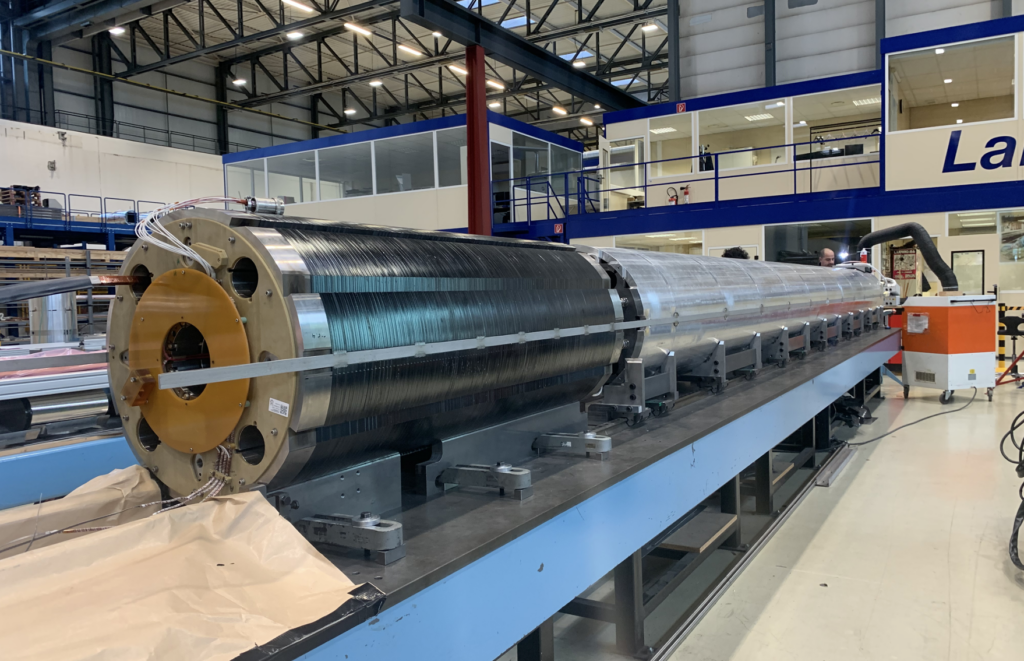
In the world of high-performance materials, few elements cover such a broad spectrum of extreme properties as Niobium. Although the metal is less known to the general public than Titanium or Steel, it is the absolute backbone of modern medical diagnostics and fundamental physics. Whether it is generating gigantic magnetic fields in particle accelerators or increasing heat resistance in jet engines: Niobium is a unique metal with a wide range of applications across diverse markets.
In this article, we dive deep into the world of this metal, explain the historical confusion surrounding its naming, and discuss how superconducting Alloys such as NbTi and Nb3Sn push the boundaries of technology.
Columbium Niobium: two names for one element
Those who delve into the archives of the American industry or study older technical drawings often encounter the term Columbium. This regularly causes confusion among engineers and purchasers. The truth is simple: Columbium and Niobium are exactly the same element.
The name Columbium was given in 1801 by the discoverer Charles Hatchett, while the name Niobium was used in Europe. Only in 1949 did IUPAC officially decide that Niobium is the international standard name. Nevertheless, the term Columbium is still occasionally used in American metallurgy and the oil and gas industry. At Metel, we always refer to Niobium, but we understand the context of both terms when assessing your specifications.
Properties of Niobium and the phenomenon of superconductivity
Niobium is a shiny, gray transition metal with a density of 8.57 g/cm³. What makes the metal unique for the engineer, however, are the physical limits it can reach. The melting point of Niobium is an impressive 2468 degrees Celsius, placing it among the refractory metals.
The most revolutionary of Niobium’s properties is superconductivity. Niobium has the highest critical temperature for superconductivity of all elemental metals (9.25 Kelvin). This means it can conduct electricity without any resistance and without energy loss at extremely low temperatures. This phenomenon forms the basis for the most powerful electromagnets in the world, such as those used in the Large Hadron Collider (LHC) at CERN.
Practical workability for the engineer
For processability, it is good to know that Niobium is very ductile at room temperature. It can be relatively easily cold-formed, provided the right protection against oxidation is applied. Due to its high affinity for oxygen, welding and processing at high temperatures must always be done in a vacuum or under an inert gas such as argon.
For you as an engineer, this means a twofold challenge in practice. On the one hand, Niobium is softer than metals like Wolfram or Molybdenum, making cold forming (such as bending or deep drawing) more accessible. On the other hand, Niobium tends to gall or stick to the tool during machining. This requires very sharp cutting tools, often carbide, and a constant flow of coolant under high pressure.
If you consider performing the processing yourself, you must take into account the need for specialized welding facilities (TIG welding in a glovebox or electron beam welding in vacuum) and vacuum ovens for any stress-relief annealing. For complex parts or critical welds, outsourcing to a specialist is often the technically safest and economically most responsible choice. Metel not only supplies the raw material but can also facilitate the step to a finished semi-finished product for you.
Niobium vs Tantalum: the strategic ‘brothers’
In metallurgy, Niobium and Tantalum are often mentioned in the same breath. They almost always occur together in nature in the same ore and are therefore sometimes called ‘chemical brothers.’ For you as an engineer, the comparison between these two is essential for cost-efficient design.
Although Tantalum is often seen as the ‘superior’ variant due to its even higher corrosion resistance and density, Niobium is in many cases an excellent and especially more affordable alternative. Niobium is lighter (with a density of 8.57 g/cm³ versus Tantalum’s 16.6 g/cm³) and significantly more favorable in purchase price. For applications where Tantalum’s extreme resistance is not pushed to the absolute limit, Niobium often offers exactly the right balance between performance and budget. Although Niobium is not yet on every technical bureau’s radar, it is worth considering this metal as a serious option to reduce your material costs. Metel can of course tell you more about the availability and properties of this metal.
Niobium Zirconium and other advanced superconducting Alloys
Although pure Niobium is already superconducting, Alloys are often used for industrial applications that can withstand higher magnetic fields or are mechanically stronger.
Niobium Zirconium (NbZr) The Niobium Zirconium Alloy is a classic in nuclear energy and superconductivity. The addition of Zirconium not only increases the mechanical strength of the material but also improves corrosion resistance in aggressive chemical environments.
In addition, we supply various other crucial Alloys:
- NbTi (Niobium-Titanium): The most widely used superconducting Alloy in the world, essential for MRI scanners due to its good processability into thin wires.
- Nb3Sn (Niobium-Tin): Used when extremely high magnetic fields (above 12 Tesla) are required. The material is more brittle than NbTi but performs superiorly in particle accelerators.
- NbHf (Niobium-Hafnium): Often referred to as C103. This Alloy is the standard for rocket nozzles and thrusters due to its unprecedented heat stability.
- NbTa (Niobium-Tantalum): Used in situations where extreme corrosion resistance must go hand in hand with high temperature resistance.
- TiAlNb (Titanium-Aluminium-Niobium): An advanced Alloy for aerospace that combines low density with high strength.
Relevant ASTM standards for certification
When specifying Niobium, the correct standards are crucial for the integrity of your project. The following standards are leading in our program:
- ASTM B391: Specification for Niobium and Alloy ingots.
- ASTM B392: The standard for Niobium rods, wires, and bar material.
- ASTM B393: Standard for Niobium plates, strips, and foils.
- ASTM B394: Specification for seamless and welded Niobium tubes.
- ASTM B652 / B652M: Specific for Niobium-Hafnium Alloys.
- ASTM B655 / B655M: Specific for Niobium-Titanium (NbTi) wires and Alloys.
Niobium applications in practice
The versatility of this metal translates into a wide range of sectors. Niobium applications are often critical: if the component fails, the entire system stops.
- Medical Technology: NbTi coils are used in MRI scanners, cooled with liquid helium. Without Niobium, the resolution needed for modern diagnoses would be impossible.
- Aerospace: Niobium-Hafnium Alloys are used for rocket engine nozzles (such as the Apollo lunar lander). The metal retains its strength while becoming glowing hot from exhaust gases.
- Chemical Industry: Due to its excellent corrosion resistance (comparable to Tantalum but lighter), Niobium is used in heat exchangers and reactors that work with aggressive acids.
- Steel Industry: As a micro-alloying element (HSLA steel), a fraction of Niobium provides a huge increase in strength and toughness, essential for oil pipelines and car bodies.
Buying Niobium and the market strategy
If you decide to buy Niobium, you enter a niche market with a unique dynamic. About 90% of Niobium mining takes place in Brazil (mainly by CBMM), followed by Canada. It is often extracted from the mineral pyrochlore. Because production is so concentrated, the market is sensitive to geopolitical shifts and export quotas.
Purchasing Niobium in the correct form – whether tubes according to ASTM B394 or rods according to ASTM B392 – requires a partner who understands international quality requirements. At Metel, we buffer market risks through close ties with producers and a sharp eye on inventories. We advise you not only on price but especially on technical feasibility: is NbTi the right choice for your magnetic application, or does your process require the extreme heat resistance of NbHf?
Conclusion: the future of Niobium and superconductivity
Niobium remains an indispensable element in the transition to a high-tech future. Whether we look at the development of nuclear fusion (ITER), where superconductivity is the key to clean energy, or the next generation of hypersonic aircraft: Niobium is at the forefront. The unique balance between superconductivity, heat resistance, and ductility means that for many applications, there simply is no alternative.
Successfully integrating Niobium into a design requires more than just a material choice; it demands a deep understanding of workability and the global availability of this scarce metal. At Metel, we understand the metallurgical complexity of superconductors and refractory Alloys and are happy to think along with you to optimize your projects technically and economically. Want to know how we can use our experience with Niobium issues for your specific market? Our team is ready to discuss the possibilities with you; contact us directly via 0416 – 724 800 or email info@metel.nl